Extra Operators
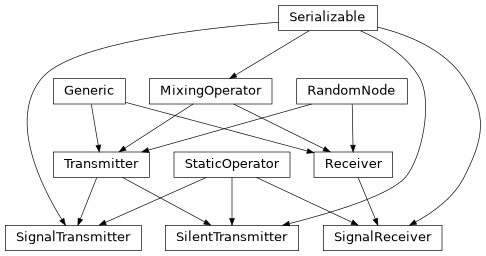
This module contains convenience transmit and receive signal processing layers used primarily for debugging and trouble shooting.
- class SilentTransmitter(num_samples, selected_transmit_ports=None)[source]
Bases:
StaticOperator,Transmitter[Transmission],SerializableSilent transmitter mock.
- Parameters:
num_samples (
int) – Number of samples per transmission.selected_transamit_ports – Digital transmit prots this dsp algorithm operates on.
- classmethod Deserialize(process)[source]
Deserialize an object’s state.
Objects cannot be deserialized directly, instead a
Factorymust be instructed to carry out the deserialization process.- Parameters:
process (
DeserializationProcess) – The current stage of the deserialization process. This object is generated by theFactoryand provides an interface to deserialization methods supporting multiple backends.- Return type:
- Returns:
The deserialized object.
- serialize(process)[source]
Serialize this object’s state.
Objects cannot be serialized directly, instead a
Factorymust be instructed to carry out the serialization process.- Parameters:
process (
SerializationProcess) – The current stage of the serialization process. This object is generated by theFactoryand provides an interface to serialization methods supporting multiple backends.- Return type:
- class SignalTransmitter(signal, *args, **kwargs)[source]
Bases:
StaticOperator,Transmitter[Transmission],SerializableCustom signal transmitter.
- Parameters:
signal (Signal) – Signal to be transmittered by the static operator for each transmission.
- classmethod Deserialize(process)[source]
Deserialize an object’s state.
Objects cannot be deserialized directly, instead a
Factorymust be instructed to carry out the deserialization process.- Parameters:
process (
DeserializationProcess) – The current stage of the deserialization process. This object is generated by theFactoryand provides an interface to deserialization methods supporting multiple backends.- Return type:
- Returns:
The deserialized object.
- serialize(process)[source]
Serialize this object’s state.
Objects cannot be serialized directly, instead a
Factorymust be instructed to carry out the serialization process.- Parameters:
process (
SerializationProcess) – The current stage of the serialization process. This object is generated by theFactoryand provides an interface to serialization methods supporting multiple backends.- Return type:
- class SignalReceiver(num_samples, selected_receive_ports=None, expected_power=0.0)[source]
Bases:
StaticOperator,Receiver[Reception],SerializableCustom signal receiver.
- Parameters:
num_samples (int) – Number of samples per transmission.
- classmethod Deserialize(process)[source]
Deserialize an object’s state.
Objects cannot be deserialized directly, instead a
Factorymust be instructed to carry out the deserialization process.- Parameters:
process (
DeserializationProcess) – The current stage of the deserialization process. This object is generated by theFactoryand provides an interface to deserialization methods supporting multiple backends.- Return type:
- Returns:
The deserialized object.
- samples_per_frame(bandwidth, oversampling_factor)[source]
Number of samples required to process at least a single frame.
- serialize(process)[source]
Serialize this object’s state.
Objects cannot be serialized directly, instead a
Factorymust be instructed to carry out the serialization process.- Parameters:
process (
SerializationProcess) – The current stage of the serialization process. This object is generated by theFactoryand provides an interface to serialization methods supporting multiple backends.- Return type: