Block Error Rate
Considering two linked modems denoted by \((\alpha)\) and \((\beta)\), with modem \((\alpha)\) transmitting a bit stream
and modem \((\beta)\) receiving a bit stream
which can be partitioned into \(L\) bit block segments of equal length
Hermes defines the block error rate (BLER) as the exepcted number of block errors between the streams, i.e.,
In practice, the number of bits \(B\) may differ between transmitter and receiver. In this case, the shorter bit stream is padded with zeros.
The following minimal examples outlines how to configure this evaluator within the context of a simulation campaign:
 1# Create a new simulation featuring two devices
 2simulation = Simulation()
 3device_alpha = simulation.new_device(bandwidth=1e8, oversampling_factor=8)
 4device_beta = simulation.new_device(bandwidth=1e8, oversampling_factor=8)
 5
 6# Create a transmitting and receiving modem for each device, respectively
 7modem_alpha = TransmittingModem()
 8device_alpha.transmitters.add(modem_alpha)
 9modem_beta = ReceivingModem()
10device_beta.receivers.add(modem_beta)
11
12# Configure the modem's waveform
13waveform_configuration = {
14    'num_preamble_symbols': 10,
15    'num_data_symbols': 100,
16}
17modem_alpha.waveform = RootRaisedCosineWaveform(**waveform_configuration)
18modem_beta.waveform = RootRaisedCosineWaveform(**waveform_configuration)
19
20simulation.add_evaluator(BlockErrorEvaluator(modem_alpha, modem_beta))
21simulation.new_dimension('noise_level', dB(0, 2, 4, 8, 10, 12, 14, 16, 18, 20), device_beta)
22simulation.num_samples = 1000
23result = simulation.run()
24
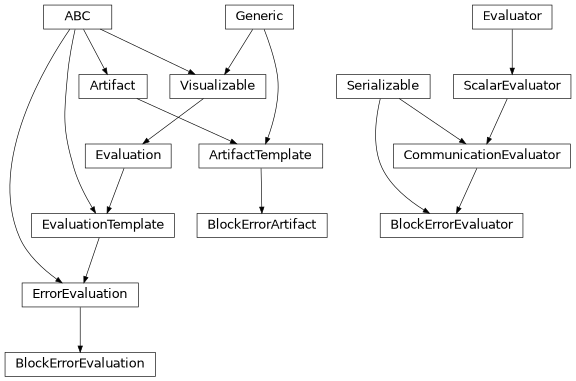
- class BlockErrorEvaluator(transmitting_modem, receiving_modem, confidence=1.0, tolerance=0.0, min_num_samples=1024, plot_scale='log', tick_format=ValueType.LIN, plot_surface=True)[source]
Bases:
CommunicationEvaluator,SerializableEvaluate block errors between two modems exchanging information.
- Parameters:
transmitting_modem (
TransmittingModem) – Communication modem transmitting information.receiving_modem (
ReceivingModem) – Communication modem receiving information.confidence (
float) – Required confidence level for the given tolerance between zero and one.tolerance (
float) – Acceptable non-negative bound around the mean value of the estimated scalar performance indicator.min_num_samples (
int) – Minimum number of samples required to compute the confidence bound.plot_scale (
str) – Scale of the plot. Can be'linear'or'log'.tick_format (
ValueType) – Tick format of the plot.plot_surface (
bool) – Enable surface plotting for two-dimensional grids. Enabled by default.
- evaluate()[source]
Evaluate the state of an investigated object.
Implements the process of extracting an arbitrary performance indicator, represented by the returned
Artifact\(X_m\).Returns: Artifact \(X_m\) resulting from the evaluation.
- Return type:
- class BlockErrorArtifact(artifact)[source]
Bases:
ArtifactTemplate[float64]Artifact of a block error evaluation between two modems exchanging information.
- Parameters:
artifact (
TypeVar(FAT, bound=SupportsFloat)) – Artifact value.
- class BlockErrorEvaluation(evaluation)[source]
Bases:
ErrorEvaluationBlock error evaluation of a single communication process between modems.