Waveform
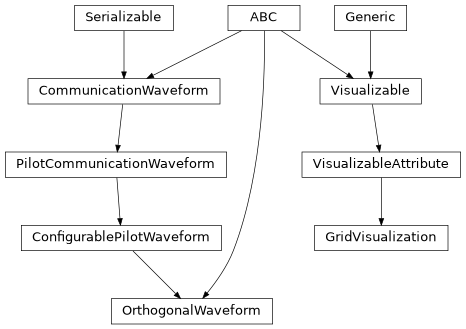
- class OrthogonalWaveform(num_subcarriers, grid_resources, grid_structure, pilot_section=None, pilot_sequence=None, repeat_pilot_sequence=True, **kwargs)[source]
Bases:
ConfigurablePilotWaveform,ABCBase class for wavforms with orthogonal subcarrier modulation.
- Parameters:
num_subcarriers (
int) – Number of available orthogonal subcarriers per symbol.grid_resources (
Sequence[GridResource]) – Grid resources available for modulation.grid_structure (
Sequence[GridSection]) – Grid structure of the time-domain.pilot_section (
PilotSection|None) – Pilot section transmitted at the beginning of each frame.pilot_sequence (
PilotSymbolSequence|None) – Sequence of pilot / reference symbols.repeat_pilot_sequence (
bool) – Repeat the pilot sequence if it is shorter than the frame.
- classmethod Deserialize(process)[source]
Deserialize an object’s state.
Objects cannot be deserialized directly, instead a
Factorymust be instructed to carry out the deserialization process.- Parameters:
process (
DeserializationProcess) – The current stage of the deserialization process. This object is generated by theFactoryand provides an interface to deserialization methods supporting multiple backends.- Return type:
- Returns:
The deserialized object.
- demodulate(signal, bandwidth, oversampling_factor)[source]
Demodulate a base-band signal stream to data symbols.
- Parameters:
- Return type:
- Returns:
The demodulated communication symbols
- map(data_bits)[source]
Map a stream of bits to data symbols.
- Parameters:
data_bits (
ndarray) – Vector containing a sequence of L hard data bits to be mapped onto data symbols.- Return type:
Returns: Mapped data symbols.
- modulate(data_symbols, bandwidth, oversampling_factor)[source]
Modulate a stream of data symbols to a base-band signal containing a single data frame.
- Parameters:
- Return type:
- Returns:
Samples of the modulated base-band signal.
- pick(placed_symbols)[source]
Pick the mapped symbols from the communicaton frame.
Additionally removes interleaved pilot symbols.
- Parameters:
placed_symbols (
StatedSymbols) – The placed symbols.- Return type:
Returns: The symbols with the mapped symbols picked from the frame.
- pilot_signal(bandwidth, oversampling_factor)[source]
Model of the pilot sequence within this communication waveform.
- Parameters:
- Return type:
Returns: The pilot sequence.
- place(symbols)[source]
Place the mapped symbols within the communicaton frame.
Additionally interleaves pilot symbols.
Returns: The symbols with the mapped symbols placed within the frame.
- samples_per_frame(bandwidth, oversampling_factor)[source]
Number of time-domain samples per processed communication frame.
- Parameters:
Note that the overall sampling rate is defined as bandwidth * oversampling_factor.
- Returns:
Number of samples per frame.
- Return type:
- serialize(process)[source]
Serialize this object’s state.
Objects cannot be serialized directly, instead a
Factorymust be instructed to carry out the serialization process.- Parameters:
process (
SerializationProcess) – The current stage of the serialization process. This object is generated by theFactoryand provides an interface to serialization methods supporting multiple backends.- Return type:
- symbol_energy(bandwidth, oversampling_factor)[source]
Expected energy of a single communication symbol within the modulated baseband-signal.
- Parameters:
Typically denoted by \(E_s\). HermesPy defines the symbol energy as the expected sum of squared magnitudes
\[E_s = \sum_{n=0}^{N-1} |x[n]|^2\]where \(x[n]\) are the complex base-band samples of a single communication symbol.
- Returns:
The expected symbol energy.
- Return type:
- property grid_resources: Sequence[GridResource][source]
Available resources within the time-subcarrier grid.
- property grid_structure: Sequence[GridSection][source]
Structure of the time-subcarrier grid.
- property mapping: PskQamMapping[source]
Constellation mapping used to translate bit sequences into complex symbols.
- property modulation_order: int[source]
Access the modulation order.
- Returns:
The modulation order.
- Return type:
- property num_data_symbols: int[source]
Number of bit-mapped symbols contained within each communication frame.
- property num_subcarriers: int[source]
Number of available orthogonal subcarriers.
- Raises:
ValueError – If smaller than one.
- property pilot_section: PilotSection | None[source]
Static pilot section transmitted at the beginning of each OFDM frame.
Required for time-domain synchronization and equalization of carrier frequency offsets.
- Returns:
FrameSection of the pilot symbols, None if no pilot is configured.
- property plot_grid: GridVisualization[source]
Visualize the resource grid.
- property power: float[source]
Expected in-band power of the generated baseband-signal for within given target bandwidth.
Typically denoted by \(P\).
- Returns:
The expected power of the modulated signal.
- class OWT[source]
Type variable for orthogonal waveform types.
alias of TypeVar(‘OWT’, bound=
OrthogonalWaveform)
- class GridVisualization(wave)[source]
Bases:
VisualizableAttribute[ImageVisualization]Plot the grid structure of an orthogonal waveform.
- Parameters:
wave (
OrthogonalWaveform) – Waveform this plot is associated with.