Section
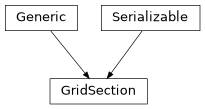
- class GridSection(num_repetitions=1, sample_offset=0, wave=None)[source]
Bases:
Generic[OWT],SerializableDescription of a part of a grid’s time domain.
- Parameters:
- abstract num_samples(bandwidth, oversampling_factor)[source]
Number of samples within this OFDM time-section.
- Parameters:
- Return type:
Returns: Number of samples within this section.
- abstract pick_samples(signal, bandwidth, oversampling_factor)[source]
Pick this section’s samples from the time-domain signal.
- Parameters:
- Return type:
Returns: Time-domain signal with the section’s samples picked.
- pick_symbols(grid)[source]
Pick this section’s data symbols from the resource grid.
- Parameters:
grid (
ndarray) – Resource grid. Two dimensional numpy array of size num_words`x`num_subcarriers.- Return type:
Returns: Data symbols. Numpy vector of size num_symbols.
- abstract place_samples(signal, bandwidth, oversampling_factor)[source]
Place this section’s samples into the time-domain signal.
- Parameters:
- Return type:
Returns: Time-domain signal with the section’s samples placed.
- place_symbols(data_symbols, reference_symbols)[source]
Place this section’s symbols into the resource grid.
- Parameters:
- Return type:
Returns: Two dimensional numpy array of size num_words`x`num_subcarriers.
- serialize(process)[source]
Serialize this object’s state.
Objects cannot be serialized directly, instead a
Factorymust be instructed to carry out the serialization process.- Parameters:
process (
SerializationProcess) – The current stage of the serialization process. This object is generated by theFactoryand provides an interface to serialization methods supporting multiple backends.- Return type:
- property num_repetitions: int[source]
Number of section repetitions in the time-domain of an OFDM grid.
- property num_words: int[source]
Number of OFDM symbols, i.e. words of subcarrier symbols this section can modulate.