Radio-Frequency Block
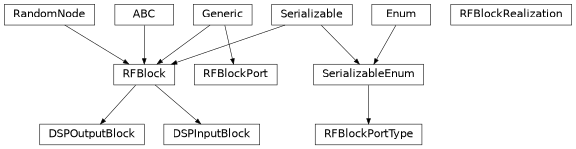
- class RFBlock(noise_model=None, noise_level=None, seed=None)[source]
Bases:
ABC,Generic[RFBRT],RandomNode,SerializableBase class of a single block within physical models of radio-frequency chains.
- Parameters:
noise_model (
NoiseModel|None) – Assumed noise model of the block. If not specified, i.e.None, additive white Gaussian noise will be assumed.noise_level (
NoiseLevel|None) – Assumed noise level of the block. If not specified, i.e.None, no noise is assumed.seed (
int|None) – Seed with which to initialize the block’s random state.
- propagate(realization, input, filter=True)[source]
Propagate the input signals through the radio-frequency block.
- Parameters:
realization (
TypeVar(RFBRT, bound=RFBlockRealization)) – Current state of the radio-frequency block.inputs – List of input signals to propagate through the block.
filter (
bool) – Whether to apply an anti-aliasing filter after propagation. Only relevant if the propagated signal is oversampled, i.e. oversampling_factor > 1. Enabled by default.
- Raises:
ValueError – If the number of input signals does not match the
num_input_ports.- Return type:
Returns: Propagated signal block containing
num_output_portsindividual signal streams.
- abstract realize(bandwidth, oversampling_factor, carrier_frequency)[source]
Return the current state of the radio-frequency block.
- Parameters:
- Return type:
TypeVar(RFBRT, bound=RFBlockRealization)- Returns:
Current state of the radio-frequency block.
- property noise_level: NoiseLevel[source]
This block’s assumed noise level.
- property noise_model: NoiseModel[source]
This block’s assumed noise model.
- class DSPInputBlock(noise_model=None, noise_level=None, seed=None)[source]
Bases:
RFBlockBase class for radio-frequency blocks representing ports connecting transmitting DSP layers to the radio-frequency chain.
RF blocks inheriting from this class will automatically be represented as ports in the RF chain.
- Parameters:
noise_model (
NoiseModel|None) – Assumed noise model of the block. If not specified, i.e.None, additive white Gaussian noise will be assumed.noise_level (
NoiseLevel|None) – Assumed noise level of the block. If not specified, i.e.None, no noise is assumed.seed (
int|None) – Seed with which to initialize the block’s random state.
- class DSPOutputBlock(noise_model=None, noise_level=None, seed=None)[source]
Bases:
RFBlockBase class for radio-frequency blocks representing ports connecting receiving DSP layers to the radio-frequency chain.
RF blocks inheriting from this class will automatically be represented as ports in the RF chain.
- Parameters:
noise_model (
NoiseModel|None) – Assumed noise model of the block. If not specified, i.e.None, additive white Gaussian noise will be assumed.noise_level (
NoiseLevel|None) – Assumed noise level of the block. If not specified, i.e.None, no noise is assumed.seed (
int|None) – Seed with which to initialize the block’s random state.
- class RFBlockRealization(bandwidth, oversampling_factor, noise_realization)[source]
Bases:
objectBase class for the realiztation of a radio-frequency block.
- Parameters:
sampling_rate – Sampling rate of the block in Hz.
oversampling_factor (
int) – Oversampling factor of the modeling in Hz.noise_realization (
NoiseRealization) – Noise realization of the block.
- property noise_realization: NoiseRealization[source]
Noise realization of the block.
- class RFBlockPort(block, port_indices, port_type)[source]
-
Representation of a single port of a radio-frequency block.
- Parameters:
block (
TypeVar(RFBT, bound=RFBlock)) – Block instance this port belongs to.port_indices (
SupportsInt|Iterable[int]) – Integer indices of the represented port or sequence of ports.port_type (
RFBlockPortType) – Type of the port, either input or output.
- property port_type: RFBlockPortType[source]
Type of the port, either input or output.
- class RFBlockPortType(value, names=<not given>, *values, module=None, qualname=None, type=None, start=1, boundary=None)[source]
Bases:
SerializableEnumEnumeration of the types of ports in a radio-frequency block.
- class RFBT[source]
Type variable for radio-frequency blocks.
alias of TypeVar(‘RFBT’, bound=
RFBlock)
- class RFBRT[source]
alias of TypeVar(‘RFBRT’, bound=
RFBlockRealization)