Texas Instruments xWR1843
Note
These presets are currently under active development and may still contain inaccuracies.
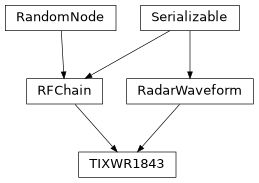
Implementation of a block-based radio-frequency front-end model following the datasheet of Texas Instruments’ AWR1843 and IWR1843 radar SoCs. It can be used within a simulation-context by assigning it as a simulated device’s rf chain model and as a monostatic radar DSP’s waveform description:
 1# Initialize a simulation scenario with a single device
 2scenario = SimulationScenario()
 3device = scenario.new_device(
 4    carrier_frequency=carrier_frequency,
 5    bandwidth=3e9,
 6    oversampling_factor=2
 7)
 8
 9# Configure the device with the XWR1843 RF chain preset
10rf = TIXWR1843()
11device.rf = rf
12
13# Configure the device antennas as a 3x4 patch antenna array
14device.antennas = SimulatedCustomArray()
15for _ in range(3):
16    device.antennas.add_antenna(SimulatedPatchAntenna(AntennaMode.TX))
17for _ in range(4):
18    device.antennas.add_antenna(SimulatedPatchAntenna(AntennaMode.RX))
19
20# Configure a radar DSP algorithm
21device.add_dsp(Radar(
22    waveform=rf,
23    receive_beamformer=ConventionalBeamformer(),
24))
- class TIXWR1843(carrier_frequency=77500000000.0, num_chirps=16, chirp_bandwidth=3000000000.0, chirp_slope=100000000000000.0, chirp_interval=3e-05, hpf_cutoff=175000.0, seed=None)[source]
Bases:
RadarWaveform,RFChainModel of the Texas Instruments AWR1843 / IWR1843 radar SoC.
- Parameters:
carrier_frequency (
float) – Center frequency of the generated signal in Hz.num_chirps (
int) – Number of chirps in the FMCW ramp.chirp_bandwidth (
float) – Bandwidth of the chirp in Hz.chirp_slope (
float) – Chirp slope in Hz/s.chirp_interval (
float) – Time between two consecutive chirps in seconds.hpf_cutoff (
float) – Cutoff frequency of the high-pass filter applied to the received signal in Hz.seed (
int|None) – Seed with which to initialize the random state of the model.
- energy(bandwidth, oversampling_factor)[source]
Energy of the radar waveform.
- Parameters:
- Return type:
Radar energy in \(\mathrm{Wh}\).
- estimate(signal, state)[source]
Generate a range-doppler map from a single-stream radar frame.
- Parameters:
signal (
Signal) – Single-stream signal model of a single propagated radar frame.state (
ReceiveState) – State of the device the radar is assigned to.
- Return type:
- Returns:
Numpy matrix (2D array) of the range-doppler map, where the first dimension indicates discrete doppler frequency bins and the second dimension indicates discrete range bins.
- frame_duration(bandwidth)[source]
Duration of a single radar frame in seconds.
Denoted by \(T_{\mathrm{F}}\) of unit \(\left[ T_{\mathrm{F}} \right] = \mathrm{s}\) in literature.
- max_range(bandwidth)[source]
The waveform’s maximum detectable range in meters.
Denoted by \(R_{\mathrm{Max}}\) of unit \(\left[ R_{\mathrm{Max}} \right] = \mathrm{m}\) in literature.
- ping(state)[source]
Generate a single radar frame.
- Parameters:
state (
TransmitState) – State of the device the radar is assigned to.- Return type:
- Returns:
Single-stream signal model of a single radar frame.
- range_resolution(bandwidth)[source]
Resolution of the radial range sensing in meters.
Denoted by \(\Delta R\) of unit \(\left[ \Delta R \right] = \mathrm{m}\) in literature.
- property max_relative_doppler: float[source]
Maximum relative detectable radial doppler frequency shift in Hz.
\[\Delta f_\mathrm{Max} = \frac{v_\mathrm{Max}}{\lambda}\]
- property ramp: RampGenerator[source]
FMCW ramp generator block model.