Noise Level
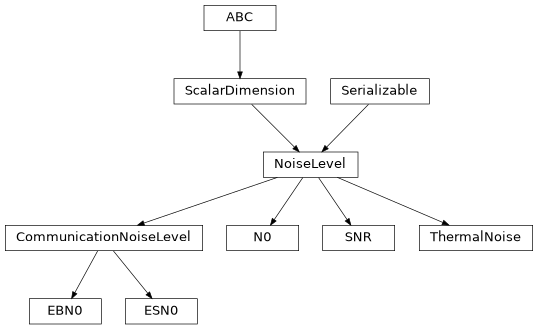
- class NoiseLevel[source]
Bases:
ScalarDimension,SerializableBase class for all noise level configuration classes.
- abstract property level: float[source]
Scalar level of the represented noise.
- Raises:
ValueError – If the noise level is negative.
General Noise Level
- class ThermalNoise(temparature)[source]
Bases:
NoiseLevelThermal noise configuration.
- Parameters:
temparature (
float) – Absolute temparature in Kelvin.
- classmethod Deserialize(process)[source]
Deserialize an object’s state.
Objects cannot be deserialized directly, instead a
Factorymust be instructed to carry out the deserialization process.- Parameters:
process (
DeserializationProcess) – The current stage of the deserialization process. This object is generated by theFactoryand provides an interface to deserialization methods supporting multiple backends.- Return type:
- Returns:
The deserialized object.
- serialize(process)[source]
Serialize this object’s state.
Objects cannot be serialized directly, instead a
Factorymust be instructed to carry out the serialization process.- Parameters:
process (
SerializationProcess) – The current stage of the serialization process. This object is generated by theFactoryand provides an interface to serialization methods supporting multiple backends.- Return type:
- property level: float[source]
Absolute temparature in Kelvin.
- Raises:
ValueError – If the temparature is negative.
- class N0(power)[source]
Bases:
NoiseLevelFixed noise power configuration.
- Parameters:
power (
float) – Noise power in Watt.
- classmethod Deserialize(process)[source]
Deserialize an object’s state.
Objects cannot be deserialized directly, instead a
Factorymust be instructed to carry out the deserialization process.- Parameters:
process (
DeserializationProcess) – The current stage of the deserialization process. This object is generated by theFactoryand provides an interface to deserialization methods supporting multiple backends.- Return type:
- Returns:
The deserialized object.
- serialize(process)[source]
Serialize this object’s state.
Objects cannot be serialized directly, instead a
Factorymust be instructed to carry out the serialization process.- Parameters:
process (
SerializationProcess) – The current stage of the serialization process. This object is generated by theFactoryand provides an interface to serialization methods supporting multiple backends.- Return type:
- property level: float[source]
Power of the noise in Watt.
- Raises:
ValueError – If the noise power is negative.
- property power: float[source]
Power of the noise level in Watt.
- Raises:
ValueError – If the noise power is negative.
- class SNR(snr, reference, channel=None)[source]
Bases:
NoiseLevelSignal-to-noise ratio configuration.
- Parameters:
snr (
float) – Expected signal-to-noise ratio.reference (
Device|Transmitter|Receiver) – Reference of the noise level, i.e. with which power or energy was the signal generated.channel (
Channel|None) – Channel instance over which the signal was propagated. For channel models that consider propagation losses the noise power is scaled accordingly.
- classmethod Deserialize(process)[source]
Deserialize an object’s state.
Objects cannot be deserialized directly, instead a
Factorymust be instructed to carry out the deserialization process.- Parameters:
process (
DeserializationProcess) – The current stage of the deserialization process. This object is generated by theFactoryand provides an interface to deserialization methods supporting multiple backends.- Return type:
- Returns:
The deserialized object.
- serialize(process)[source]
Serialize this object’s state.
Objects cannot be serialized directly, instead a
Factorymust be instructed to carry out the serialization process.- Parameters:
process (
SerializationProcess) – The current stage of the serialization process. This object is generated by theFactoryand provides an interface to serialization methods supporting multiple backends.- Return type:
- property level: float[source]
Linear signal power to noise power ratio.
- Raises:
ValueError – If the ratio negative.
- property reference: Device | Transmitter | Receiver[source]
Reference to which the noise level is scaled.
Can be either a device, transmitter or receiver. If assigned to a device,
- property snr: float[source]
Linear signal power to noise power ratio.
- Raises:
ValueError – If the ratio negative.
Communication Noise Level
- class CommunicationNoiseLevel(reference, level=inf)[source]
Bases:
NoiseLevelBase class for all communication noise level configuration classes.
- Parameters:
reference (
BaseModem|CommunicationWaveform) – Reference with respect to which the noise level is defined.level (
float) – Noise level relative to the reference’
- property level: float[source]
Communication relative noise level.
- Raises:
ValueError – For non-positive noise levels.
- property reference: BaseModem | CommunicationWaveform[source]
Reference of the noise level.
Returns: Reference of the noise level.
Eb/N0
The bit energy to noise power spectral density ratio (Eb/N0) is a fundamental parameter in digital communication systems. It is defined as the ratio of the energy per bit to the noise power spectral density. The Eb/N0 is a key parameter in the design of digital communication systems, and is used to determine the minimum signal-to-noise ratio required to achieve a certain bit error rate.
- class EBN0(reference, level=inf)[source]
Bases:
CommunicationNoiseLevelFixed noise power configuration.
- Parameters:
reference (
BaseModem|CommunicationWaveform) – Reference with respect to which the noise level is defined.level (
float) – Noise level relative to the reference’
Es/N0
The symbol energy to noise power spectral density ratio (ES/N0) is a measure of the signal-to-noise ratio (SNR) in a communication system. It is defined as the ratio of the energy per symbol to the noise power spectral density. The ES/N0 is a key parameter in the design of digital communication systems, and is used to determine the required signal-to-noise ratio for a given bit error rate.
- class ESN0(reference, level=inf)[source]
Bases:
CommunicationNoiseLevelFixed noise power configuration.
- Parameters:
reference (
BaseModem|CommunicationWaveform) – Reference with respect to which the noise level is defined.level (
float) – Noise level relative to the reference’