Self-Interference
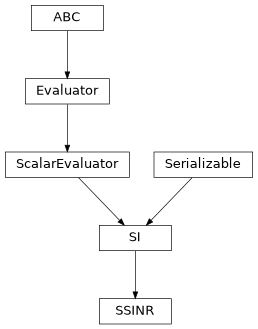
- class SI(device, confidence=1.0, tolerance=0.0, min_num_samples=1024, plot_scale='linear', tick_format=ValueType.LIN, plot_surface=True)[source]
Bases:
ScalarEvaluator,SerializableEvaluate a simulated device’s self-interference power.
- Parameters:
device (
SimulatedDevice) – The device to evaluate.confidence (
float) – Required confidence level for the given tolerance between zero and one.tolerance (
float) – Acceptable non-negative bound around the mean value of the estimated scalar performance indicator.min_num_samples (
int) – Minimum number of samples required to compute the confidence bound.plot_scale (
str) – Scale of the plot. Can be'linear'or'log'.tick_format (
ValueType) – Tick format of the plot.plot_surface (
bool) – Enable surface plotting for two-dimensional grids. Enabled by default.
- classmethod Deserialize(process)[source]
Deserialize an object’s state.
Objects cannot be deserialized directly, instead a
Factorymust be instructed to carry out the deserialization process.- Parameters:
process (
DeserializationProcess) – The current stage of the deserialization process. This object is generated by theFactoryand provides an interface to deserialization methods supporting multiple backends.- Return type:
- Returns:
The deserialized object.
- evaluate()[source]
Evaluate the state of an investigated object.
Implements the process of extracting an arbitrary performance indicator, represented by the returned
Artifact\(X_m\).Returns: Artifact \(X_m\) resulting from the evaluation.
- Return type:
- serialize(process)[source]
Serialize this object’s state.
Objects cannot be serialized directly, instead a
Factorymust be instructed to carry out the serialization process.- Parameters:
process (
SerializationProcess) – The current stage of the serialization process. This object is generated by theFactoryand provides an interface to serialization methods supporting multiple backends.- Return type:
- class SSINR(device, confidence=1.0, tolerance=0.0, min_num_samples=1024, plot_scale='linear', tick_format=ValueType.LIN, plot_surface=True)[source]
Bases:
SISignal to self-interfernce plus noise power ratio evaluator.
- Parameters:
device (
SimulatedDevice) – The device to evaluate.confidence (
float) – Required confidence level for the given tolerance between zero and one.tolerance (
float) – Acceptable non-negative bound around the mean value of the estimated scalar performance indicator.min_num_samples (
int) – Minimum number of samples required to compute the confidence bound.plot_scale (
str) – Scale of the plot. Can be'linear'or'log'.tick_format (
ValueType) – Tick format of the plot.plot_surface (
bool) – Enable surface plotting for two-dimensional grids. Enabled by default.
- evaluate()[source]
Evaluate the state of an investigated object.
Implements the process of extracting an arbitrary performance indicator, represented by the returned
Artifact\(X_m\).Returns: Artifact \(X_m\) resulting from the evaluation.
- Return type: